Write your career stories once.
Reuse them forever.
A searchable library of your career stories, tagged by skill and trait, that feeds your interviews, cover letters and networking conversations. Write a story once and read it back as STAR, CARL, SOAR, CAR or PAR, with voice capture you won't find anywhere else.
How it works
Log a career moment
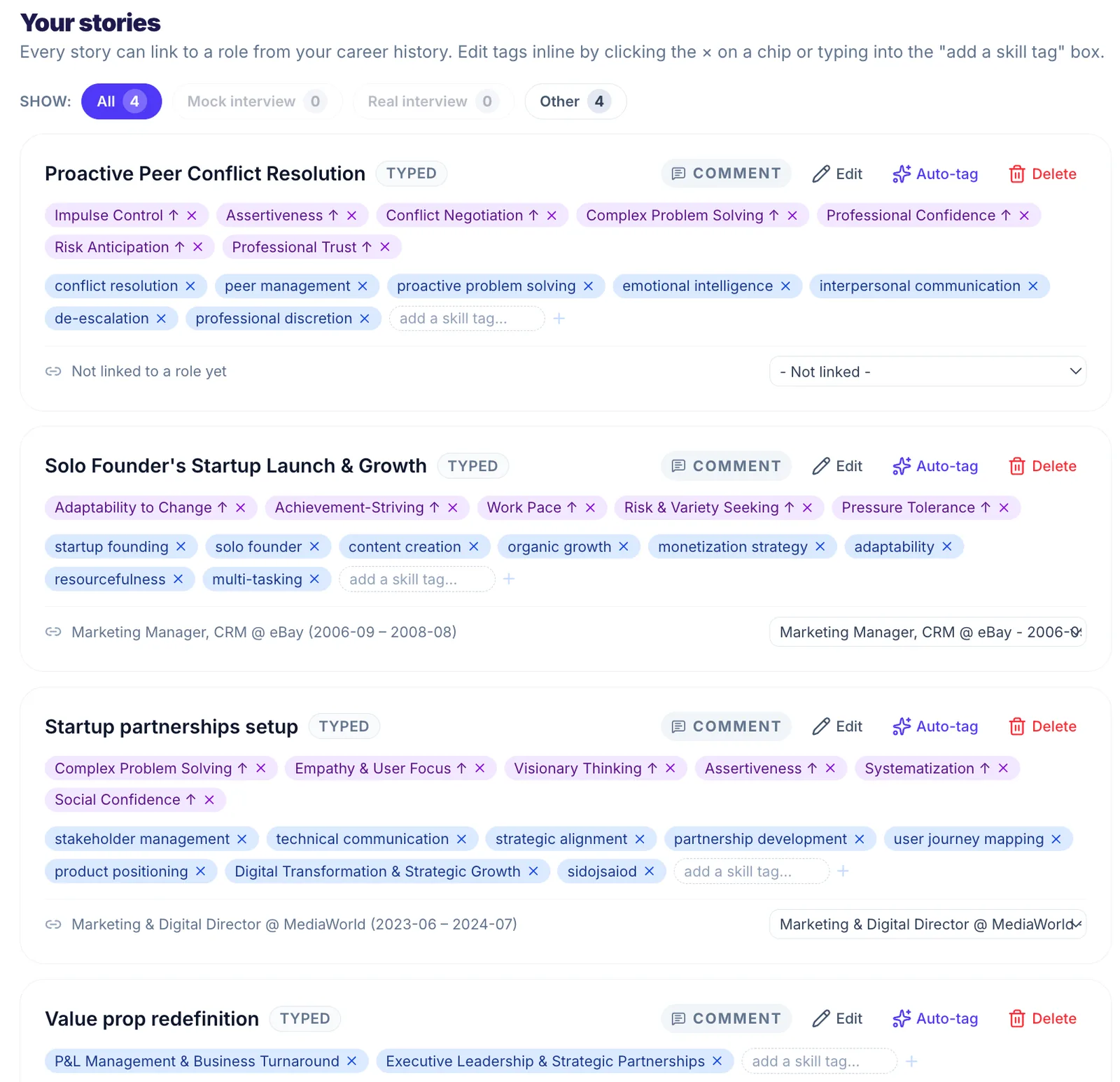
Write or paste a story, a project you led, a crisis you handled, a hard call you made. Keep it rough; we'll help you shape it.
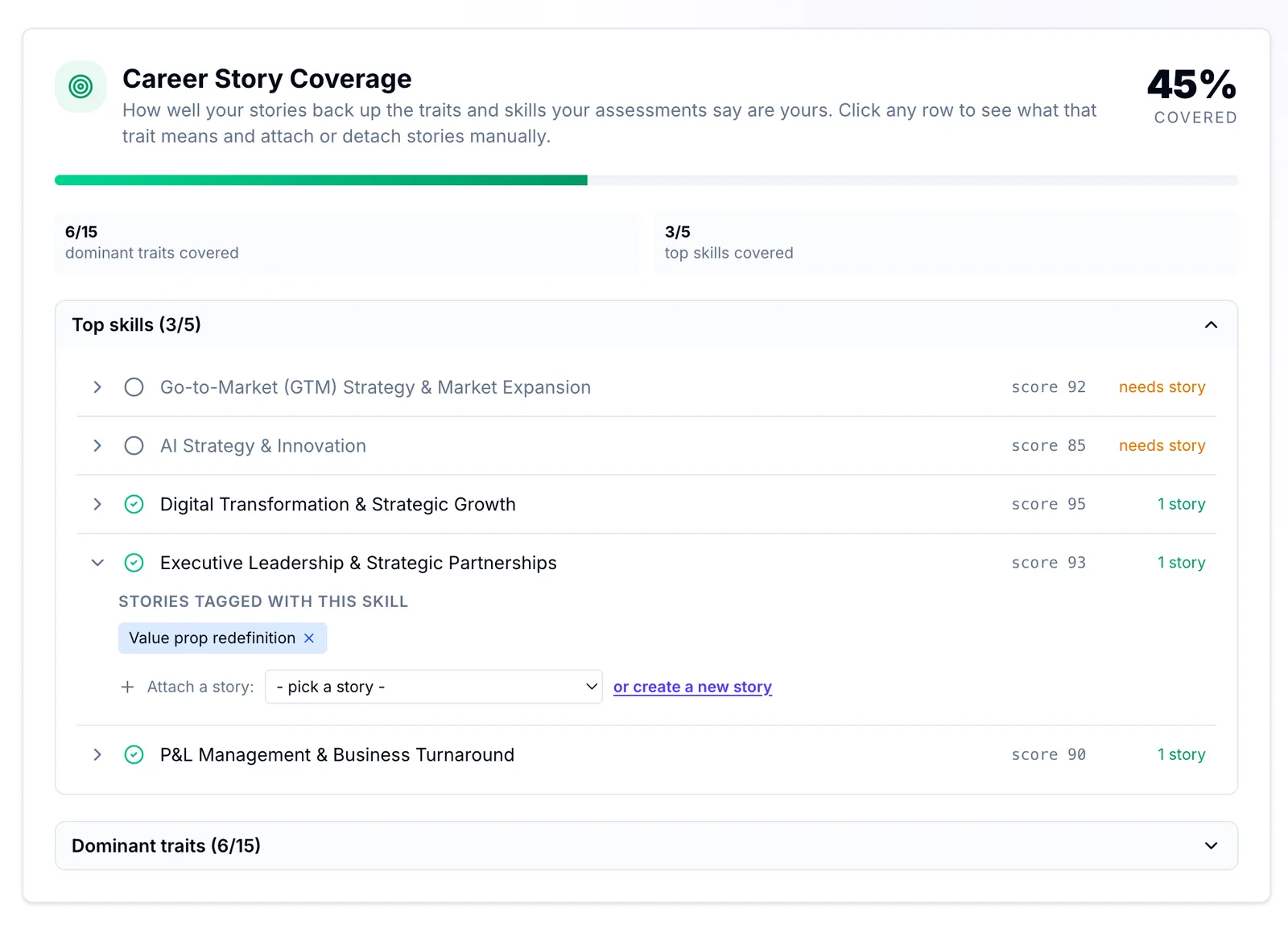
Tag it by skill and trait
Automatic suggestions tag each story with the skills it demonstrates and the WorkFive traits it reveals. Re-tag anything, anytime.
Reuse everywhere
The right stories surface automatically in Cover Letter Pro, Mock Interviews, and LinkedIn About sections. One story, many uses.
Anatomy of a STAR story
Four parts, each carrying weight. This is the default lens, and the one to learn first.
Situation
The context, briefly. Where you were, when, who was involved. Two sentences max, set the stage without burning the room's time.
Task
What you specifically had to do. Your goal, your constraint, your accountability. The interviewer is listening for ownership.
Action
What you actually did, your decisions, your tradeoffs, your judgment calls. This is the longest part of the story.
Result
What changed. Numbers when you have them, the qualitative outcome when you don't. End on impact, not effort.
STAR is the default, not the only option
A story is stored once and read back through whichever framework the room asks for. Your interviewer says STAR, your coach teaches SOAR, your CV wants PAR: same story, different boxes.
- STARSituation, Task, Action, Result. The four-box default, and the shape almost every behavioral round expects.STAR method guide
- CARLContext, Action, Result, Learning. Merges the setup into one box to make room for what the experience changed.CARL method guide
- SOARSituation, Obstacle, Action, Result. Trades the task you owned for the thing that stood in your way.SOAR method guide
- CARChallenge, Action, Result. Three boxes and one paragraph, which is what a cover letter has room for.CAR method guide
- PARProblem, Action, Result. The formula behind a CV bullet that names a number instead of a duty.PAR method guide
- Compare every interview framework
Your performance reviews and project reports already describe many of these stories.Read them in with Evidence
Voice-to-story capture
Record a 60-second rambling voice memo of a story you remember. Our engine structures the transcript into the framework you picked, STAR by default, editable before you save. Built on transcription and story parsing you won't find in any other career tool.
Why this beats a document
Most candidates keep their career stories in a scattered mess: an old performance review, a long-lost journal entry, a Slack message from two years ago. Under interview pressure, they default to 'I'm a team player who likes a challenge', and lose the offer to someone with a crisper answer.
The Story Bank fixes the root cause. Once a story is logged, tagged, and refined even once, it's always available, cross-linked to your cover letters, feeding your mock interviews, showing up in your LinkedIn About section. Refining a story twice beats inventing one on the fly every single time.
Stories every candidate should have
Cover the bases interviewers actually score against.
Leadership without authority
A time you drove an outcome through influence, no formal power, just clarity and trust.
Conflict you defused
A disagreement you handled. Not avoided, not steamrolled, actually resolved.
Ambiguity turned into action
When the brief was unclear, the data was thin, and you still moved forward responsibly.
A call that didn't go your way
A decision or project that failed. What you did about it. What you learned.
Customer or stakeholder save
A relationship you rescued, internal or external. Trust earned back, not just preserved.
Cross-functional alignment
Pulling design, engineering, sales, or legal into a shared answer. Translation across function lines.
FAQ
Frequently asked questions about the Story Bank
What is a STAR story?
STAR stands for Situation, Task, Action, Result. It's a narrative format for behavioral interview answers: here's the context, here's what I specifically had to do, here's what I actually did, here's what happened. It's the format trained recruiters and interviewers score against, and the default in the Story Bank. CARL, SOAR, CAR and PAR are the same story cut differently, and the bank stores all five.
Do I have to use STAR?
No. The Story Bank stores one story and reads it back through whichever framework you pick: STAR, CARL (which adds a Learning), SOAR (which asks what stood in your way), or CAR and PAR (three boxes, for a cover letter or a CV bullet). You choose the framework when you write the story, because merging Situation and Task into one box cannot be undone afterwards.
How many stories should I have?
Aim for 8-12 strong stories covering different skills (leadership, conflict, ambiguity, technical call, customer save) and different outcomes (won, learned from losing, saved the bigger picture). Most interviews draw from a rotation of 6-8 stories per candidate.
Can I use Story Bank for cover letters, not just interviews?
Yes, that's the point. Cover Letter Pro reads your Story Bank and picks the most relevant story for each application. LinkedIn About sections pull from there too. Log once, use everywhere.
How does voice capture work?
You record a rambling voice memo (up to 60 seconds) of a story you remember. We transcribe it, then structure the transcript into the boxes of whichever framework you picked, STAR unless you changed it. You edit before saving, and tags are applied automatically. It's a jobmentis-exclusive feature, no other career tool ships it.
Can I export my stories?
Yes. PDF export of your full Story Bank is available on the paid plan, formatted for coaching sessions or for handing to a recruiter-referral.
Next step in your career strategy
Now track every application and contact in one place.
Track
Open the Job Search CRM